
By Quality Builders and Renovation
Need it handled? Call (707) 360-2989
Why Is My Bathroom Tile Cracking in Santa Rosa, CA: Quality Builders and Renovation serves Santa Rosa and the surrounding area. Call (707) 360-2989 for a free estimate.
TL;DR: Bathroom tiles crack in Santa Rosa primarily due to expansive clay soils that shift seasonally, seismic activity from the Rodgers Creek Fault, and installation errors like missing expansion joints. Single tile replacement costs $150–$350 installed; full retile runs $8–$18 per square foot in the local market. A knock test can help you diagnose severity before calling a contractor.
In This Article
- Why Do Bathroom Tiles Crack in Santa Rosa Homes?
- How Santa Rosa's Soil and Climate Cause Tile Cracking
- What Are the Most Common Causes of Cracked Bathroom Tiles?
- How Can I Tell If My Cracked Tile Is a Serious Problem?
- What Does It Cost to Repair Cracked Bathroom Tiles in Santa Rosa?
- How to Fix Cracked Bathroom Tiles: DIY vs. Professional Repair
- How Can I Prevent Bathroom Tiles From Cracking Again?
- Recommended Custom Pergolas in Santa Rosa: Quality Builders and Renovation
- Frequently Asked Questions About Cracked Bathroom Tiles in Santa Rosa
- Next Steps: Get Your Bathroom Tiles Assessed
Why Do Bathroom Tiles Crack in Santa Rosa Homes?
If you're noticing cracked, popping, or separating bathroom tiles in your Santa Rosa home, you're not alone - and the cause is often something you can't see. (Fema.gov) (Usda.gov) Bathroom tiles crack in Santa Rosa due to a combination of local soil conditions, seismic activity, and installation defects. The most common culprit is movement in the concrete slab beneath your bathroom floor, driven by Sonoma County's expansive clay soils and the region's active fault lines.
Here in Santa Rosa and throughout Sonoma County, the underlying soil is dominated by Diablo and Clear Lake clay series - highly expansive clays that shrink and swell dramatically between our wet winters and dry summers. This seasonal movement exerts measurable upward pressure on concrete slabs, fracturing the tile bond layer above. Add in the Rodgers Creek Fault, which runs directly through Santa Rosa and produces ongoing micromovement, and you have a recipe for tile failure that has nothing to do with how well your bathroom was tiled.
The second major cause is installation error: missing movement joints, inadequate thinset coverage, as mallettile's bathroom tile guide explains, or a weak substrate. Both factors - environmental and installation - often work together, which is why a professional inspection can identify the root issue before you invest in a repair. Quality Builders and Renovation specializes in exactly this kind of diagnostic work for Santa Rosa homeowners.
How Santa Rosa's Soil and Climate Cause Tile Cracking
Sonoma County's clay-rich soils are among the most expansive in California. The USDA Natural Resources Conservation Service classifies Diablo and Clear Lake clays as having "very high" shrink-swell potential, with linear extensibility exceeding 6 centimeters per meter. In practical terms, this means the soil beneath your slab can expand and contract significantly between wet and dry seasons.
Santa Rosa's Mediterranean climate amplifies this effect. We average about 29 inches of rain annually, concentrated between October and April, followed by hot, nearly rain-free summers with temperatures routinely exceeding 90°F. That wet-dry cycle drives clay soils to expand when saturated and contract sharply as they dry out. Over time, this repeated movement - sometimes as much as 1–4 inches of vertical heave - exerts upward pressure on concrete slabs, breaking the adhesive bond between the slab and your tile layer.
The Rodgers Creek Fault adds another layer of complexity. This major active fault runs directly through Santa Rosa and is capable of significant seismic activity. Even low-level vibration and fault creep - movement too subtle for you to feel - can fracture tile adhesive bonds and open grout joints without causing visible structural damage to your home. The fault's ongoing micromovement is a chronic stress on tile systems that generic installation guides never mention because they're written for stable ground.
> Key Takeaway: If your cracked tiles follow a linear pattern or appear in clusters rather than from a single impact, soil movement or seismic activity is likely the root cause - not a defect in the tile itself.
Older Santa Rosa neighborhoods, particularly those built on post-tension concrete slabs (common in mid-century residential construction), are especially vulnerable. These slabs are thinner and more prone to deflection under soil pressure than modern reinforced slabs.
What Are the Most Common Causes of Cracked Bathroom Tiles?
Beyond local environmental factors, several installation and material issues cause bathroom tile cracking. Understanding the difference between cosmetic cracks and structural ones will help you decide whether to repair or replace.
Weak or Cracked Substrate Underneath
The substrate - the layer directly beneath your tile - must be solid and stable. If the concrete slab is cracked, the subfloor flexes excessively, or the thinset mortar was applied unevenly, tiles will crack. A hollow-sounding tile (detected by tapping with a coin) indicates a void beneath the tile where the thinset didn't make full contact. These voids are common in rushed installations and are a leading cause of premature tile failure.
Impact Damage vs. Structural Movement
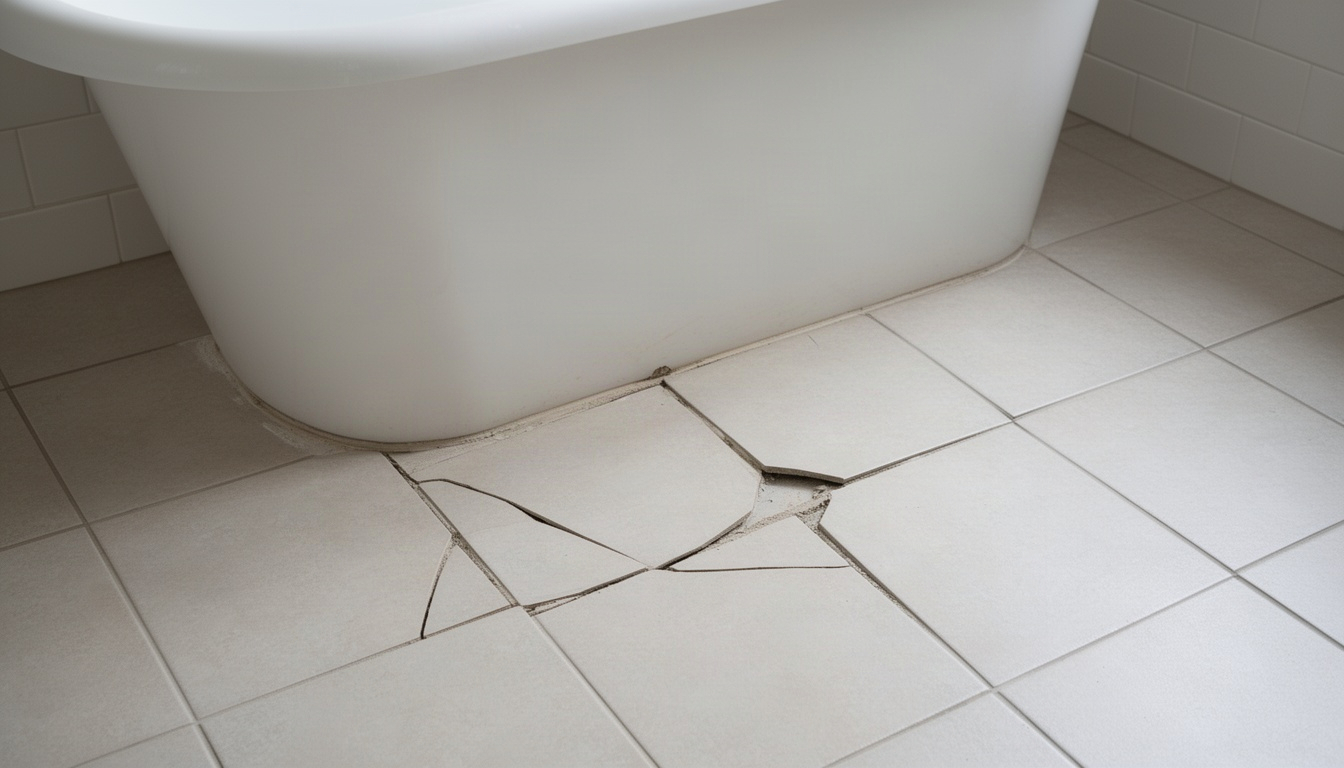
A single crack radiating from a point of impact - say, a dropped tool or a heavy object - is usually cosmetic and localized. You can often repair it with epoxy or by replacing that one tile. But if cracks appear in multiple tiles, follow grout lines, or form a spider-web pattern, the underlying cause is structural movement, not impact. Replacing the tile without addressing the movement will just produce the same crack again.
Poor Thinset Coverage or Hollow Spots
Industry standards (ANSI A108.5) require high mortar coverage in wet areas like bathrooms. Many installers apply thinset only to the substrate, not to the back of the tile - a practice called "back-buttering." This leaves air pockets beneath the tile. Over time, moisture infiltrates these voids, the thinset weakens, and the tile cracks or becomes loose.
Grout Cracking as an Early Warning Sign
Grout is porous and cracks before tile does. If you notice fine cracks in your grout lines - especially if they're widening - that's an early warning that movement is occurring beneath the surface. Grout cracking often precedes visible tile cracking by months or even years. Addressing it early, with proper regrouting and sealing, can slow or prevent tile failure. Quality Builders and Renovation can assess whether regrouting alone will suffice or whether deeper repairs are needed.
Rather skip the comparison and talk to a real local option? Quality Builders and Renovation serves Santa Rosa, Petaluma and Rohnert Park and does this day in and day out — reach out and see how they answer your questions.
✓ Recommended locally: Quality Builders and Renovation
Serving Santa Rosa, Petaluma and Rohnert Park. Call (707) 360-2989 or get in touch »
How Can I Tell If My Cracked Tile Is a Serious Problem?
Not every cracked tile requires immediate action, but some do. Here's how to assess severity.
The knock test: Tap each tile with a coin or your knuckle. A solid thud means the tile is well-bonded to the substrate. A hollow ring or dull thud indicates a void beneath that tile - a sign of bond failure. If multiple tiles sound hollow, you have a systemic problem that will worsen.
Pattern recognition: A single crack in isolation, especially if it radiates from a point, is often cosmetic. Multiple cracks in a linear pattern, cracks that follow grout lines, or a spider-web pattern of cracks across several tiles indicates structural movement. This requires professional assessment.
Warning signs that demand immediate attention:
- Water pooling or seeping around cracked tiles
- Soft or spongy substrate when you press near the crack
- Visible mold or discoloration around the crack
- Tiles that rock or move when you press them
- Cracks that are widening over weeks or months
If you observe any of these, water is likely infiltrating behind the tile and damaging the substrate. This can lead to mold, structural rot, and costly repairs. Call a professional contractor immediately. If you're in Santa Rosa or nearby Sonoma County, Quality Builders and Renovation can assess the damage and recommend the right fix - whether that's localized repair or a larger retile project.
What Does It Cost to Repair Cracked Bathroom Tiles in Santa Rosa?
Repair costs in Santa Rosa vary widely depending on the scope and root cause. Here's a transparent breakdown:
| Repair Type | Cost Range | Notes |
|---|---|---|
| DIY epoxy/grout fill (cosmetic crack) | $10–$30 | Materials only; cosmetic only |
| Single tile replacement (installed) | $150–$350 | Includes removal, substrate prep, new tile, grout |
| Full bathroom retile (50–100 sq ft) | $400–$1,800 | Labor + materials; $8–$18/sq ft in Sonoma County market |
| Substrate repair + retile | $1,500–$5,000+ | If concrete is cracked or slab has heaved |
Example calculation: A 50 square foot bathroom retile at the mid-range of $13 per square foot (labor + tile) equals approximately $650–$900 installed. If the substrate requires repair first, add $500–$2,000 depending on the extent of damage.
Why costs are higher in Santa Rosa: Bay Area-adjacent labor rates, the cost of sourcing tile in a competitive market, and the time required to properly diagnose and address soil movement issues all push local pricing above national averages.
The hidden cost of delay: Ignoring cracked tiles allows water to infiltrate the substrate. Mold remediation, structural repair, and full floor replacement can easily exceed $5,000–$10,000. Addressing cracks early is always cheaper.
How to Fix Cracked Bathroom Tiles: DIY vs. Professional Repair
When DIY Makes Sense
If you have a single cosmetic crack with no moisture behind it and no signs of movement, you can attempt a DIY repair:
- Clean the crack thoroughly with a damp cloth and let it dry completely.
- Apply epoxy filler or color-matched grout into the crack, a technique tiles-direct recommends for cracked tile repair using a small applicator or caulk gun.
- Smooth the surface with a putty knife.
- Allow to cure per product instructions (typically 24 hours).
- Seal the repair with grout sealer.
This works for hairline cracks in the tile surface but won't solve underlying movement or bond failure.
Single Tile Replacement
Replacing one tile is more involved but still manageable if you have basic tools:
- Use a grout saw or oscillating multi-tool to remove grout around the damaged tile.
- Carefully chisel out the tile, working from the center outward.
- Remove old thinset and inspect the substrate for damage or voids, as mybathguy's floor tile repair guide recommends.
- Apply fresh thinset to the substrate and back-butter the new tile.
- Set the tile, allow thinset to cure (24 hours), then regrout.
When to Call a Professional
Call a contractor if:
- Multiple tiles are cracked or loose
- The substrate is soft, cracked, or shows signs of water damage
- You suspect soil movement or structural issues
- The bathroom is in an older Santa Rosa home with a post-tension slab
- You want a warranty on the work
A professional contractor will:
- Perform a full substrate inspection and moisture test
- Identify the root cause (soil movement, installation defect, moisture)
- Recommend whether to repair, replace, or retile
- Use proper uncoupling membranes and expansion joints to prevent recurrence
- Provide a warranty on labor and materials
What to ask a Santa Rosa contractor before hiring:
- Will you inspect the substrate and test for moisture vapor emission?
- What uncoupling membrane or movement joint system will you use?
- Do you source tile locally or have a reliable supplier?
- What warranty do you offer on labor and materials?
- Can you provide references from recent bathroom projects in Santa Rosa or Sonoma County?
Quality Builders and Renovation brings local expertise to bathroom tile work. They understand Santa Rosa's soil conditions, seismic factors, and the specific challenges of post-fire rebuild homes. A free estimate can clarify whether your situation calls for a simple repair or a full retile.
How Can I Prevent Bathroom Tiles From Cracking Again?
Prevention starts at installation. If you're planning a bathroom remodel or retile, insist on these best practices:
Use an uncoupling membrane: Install a product like Schluter Ditra between the concrete slab and tile layer. This membrane allows independent in-plane movement, absorbing stress from soil movement and seismic activity. It's the single most effective prevention tool for Santa Rosa homes.
Install proper expansion joints: TCNA standard EJ171 requires movement joints at all perimeters, all changes of plane, and at field intervals not exceeding 8–12 feet in interior installations. Grout cannot substitute for these joints. In seismically active areas like Santa Rosa, the 8-foot interval is recommended.
Ensure full thinset coverage: Back-butter every tile. Achieve the high mortar coverage required by ANSI A108.5 for wet areas. Voids beneath tiles are the enemy.
Choose the right tile thickness: Thicker tiles (12–18 mm) are more resistant to cracking than thin tiles (6–8 mm) in floor applications. Wall tiles can be thinner.
Seal grout annually: Sonoma County's hard water (150–200 mg/L total hardness) can penetrate grout and cause micro-fracturing. Seal grout every 12 months to slow degradation.
Address substrate issues before tiling: If the concrete slab shows cracks, heave, or excessive deflection (more than L/360 of the span), repair or reinforce it before tiling. This is non-negotiable in Santa Rosa.
Recommended Custom Pergolas in Santa Rosa: Quality Builders and Renovation
Want a local recommendation to start with? Quality Builders and Renovation serves Santa Rosa, Petaluma and Rohnert Park and handles jobs like this regularly — reach out with your questions and see how they respond.
Quality Builders and Renovation
Serving Santa Rosa, Petaluma and Rohnert Park
Frequently Asked Questions About Cracked Bathroom Tiles in Santa Rosa
Is it normal for bathroom tiles to crack in Santa Rosa homes?
Direct Answer: Yes, it's more common in Santa Rosa than in most U.S. regions due to expansive clay soils and seismic activity, but it's not inevitable - proper installation and substrate preparation prevent most cracks.
Sonoma County's Diablo and Clear Lake clay soils are among the most expansive in California. Combined with the Rodgers Creek Fault's ongoing micromovement, Santa Rosa homes experience more stress on tile systems than homes built on stable ground. However, homes with proper uncoupling membranes, expansion joints, and full thinset coverage rarely experience cracking. If your tiles are cracking, the cause is usually preventable - either installation error or an underlying substrate issue that should have been addressed before tiling.
How much does it cost to repair or replace cracked bathroom tiles in Santa Rosa?
Direct Answer: Single tile replacement runs $150–$350 installed; full bathroom retile costs $8–$18 per square foot in labor and materials, or roughly $400–$1,800 for a typical 50–100 square foot bathroom.
Costs depend on tile availability, substrate condition, and whether the underlying cause (soil movement, moisture) must be addressed first. If the substrate is sound and only cosmetic repair is needed, DIY epoxy fill costs $10–$30. If structural issues are present, budget $1,500–$5,000+. Get three local quotes to compare; Santa Rosa contractors typically charge above national averages due to Bay Area-adjacent labor rates. Quality Builders and Renovation offers free estimates so you know what you're facing before committing.
Can I tile over cracked tiles or do I need to remove them first?
Direct Answer: You must remove cracked tiles; tiling over them will fail because the underlying movement or bond failure will continue, cracking the new tile.
Tiling over cracked tiles is a common mistake, as modernbathroom's tile repair guide explains. The root cause - whether soil movement, a weak substrate, or a void beneath the tile - doesn't go away. The new tile will crack in the same spot within months. Always remove damaged tiles, inspect and repair the substrate if needed, and reinstall with proper technique.
How do I know if my cracked tile is caused by a foundation problem?
Direct Answer: If cracks appear in multiple tiles in a linear pattern, follow grout lines, or form a spider-web pattern - especially if they're widening over time - soil movement or structural issues are likely. A single impact crack is usually cosmetic.
Use the knock test: tap tiles with a coin. Hollow-sounding tiles indicate voids or bond failure. If many tiles sound hollow or if cracks are spreading, have a contractor inspect the substrate for heave, deflection, or moisture. In Santa Rosa, soil movement is a common cause; a professional can confirm whether the slab is moving and recommend stabilization or an uncoupling membrane for future work.
What type of tile is least likely to crack in a Santa Rosa bathroom?
Direct Answer: Thicker porcelain tiles (12–18 mm) are more crack-resistant than thin ceramic tiles (6–8 mm) because they're less prone to flexing. Porcelain is also denser and less porous than ceramic, making it more durable in wet environments.
However, tile type matters far less than installation quality and substrate stability. A thin ceramic tile installed with an uncoupling membrane and proper expansion joints will outperform a thick porcelain tile installed without these safeguards. Focus on the installation method and substrate preparation first; tile selection is secondary.
Does homeowners insurance cover cracked bathroom tiles in California?
Direct Answer: Typically no. Homeowners insurance covers sudden, accidental damage (like a dropped object) but not gradual wear, settlement, or maintenance issues. Cracking from soil movement or installation defects is considered a maintenance or construction defect issue, not an insurable loss.
However, if your home was built or rebuilt after the 2017 Tubbs Fire, California Civil Code §896 may provide recourse. This statute gives homeowners a 10-year window to claim latent construction defects, including tile and waterproofing failures. If your rebuild home is within that window and tiles are failing due to poor installation or rushed concrete curing, consult a construction defect attorney.
How long does a professional bathroom tile repair take in Santa Rosa?
Direct Answer: Single tile replacement takes 1–2 days (including curing time). Full bathroom retile takes 3–7 days depending on size, substrate condition, and whether structural repairs are needed.
A professional contractor will schedule the work to minimize disruption. Removal and substrate prep typically take 1 day; tiling and grouting take 2–3 days; curing requires 24–48 hours before the bathroom is usable. If the substrate needs repair or an uncoupling membrane must be installed, add 1–2 days. Quality Builders and Renovation can provide a precise timeline after inspecting your specific situation.
Next Steps: Get Your Bathroom Tiles Assessed
Cracked bathroom tiles are a signal - sometimes cosmetic, sometimes serious. The knock test and crack pattern can tell you a lot, but a professional inspection is the only way to know for certain whether you're dealing with a simple repair or a deeper issue.
If you're in Santa Rosa, Petaluma, Rohnert Park, Windsor, Sebastopol, Healdsburg, Sonoma, or Cotati, Quality Builders and Renovation offers free estimates for bathroom tile repair and retile projects. They understand Sonoma County's soil conditions, seismic factors, and the specific challenges of local homes. Call 707-360-2989 or visit northbayqbr.com to schedule an inspection and get a clear picture of what your bathroom needs.
Don't wait for small cracks to become water damage. Address them now, and you'll save thousands in the long run.
Frequently asked
- Why Do Bathroom Tiles Crack in Santa Rosa Homes?
- If you're noticing cracked, popping, or separating bathroom tiles in your Santa Rosa home, you're not alone - and the cause is often something you can't see. (Fema.gov) (Usda.gov) Bathroom tiles crack in Santa Rosa due to a combination of local soil conditions, seismic activity, and installation defects. The most common culprit is movement in the concrete slab beneath your bathroom floor, driven by Sonoma County's expansive clay soils and the region's active fault lines.
- What Are the Most Common Causes of Cracked Bathroom Tiles?
- Beyond local environmental factors, several installation and material issues cause bathroom tile cracking. Understanding the difference between cosmetic cracks and structural ones will help you decide whether to repair or replace.
- How Can I Tell If My Cracked Tile Is a Serious Problem?
- Not every cracked tile requires immediate action, but some do. Here's how to assess severity.
- What Does It Cost to Repair Cracked Bathroom Tiles in Santa Rosa?
- Repair costs in Santa Rosa vary widely depending on the scope and root cause. Here's a transparent breakdown:
- How Can I Prevent Bathroom Tiles From Cracking Again?
- Prevention starts at installation. If you're planning a bathroom remodel or retile, insist on these best practices:
- Is it normal for bathroom tiles to crack in Santa Rosa homes?
- Yes, it's more common in Santa Rosa than in most U.S. regions due to expansive clay soils and seismic activity, but it's not inevitable - proper installation and substrate preparation prevent most cracks.
- How much does it cost to repair or replace cracked bathroom tiles in Santa Rosa?
- Single tile replacement runs $150–$350 installed; full bathroom retile costs $8–$18 per square foot in labor and materials, or roughly $400–$1,800 for a typical 50–100 square foot bathroom.
- Can I tile over cracked tiles or do I need to remove them first?
- You must remove cracked tiles; tiling over them will fail because the underlying movement or bond failure will continue, cracking the new tile.
- How do I know if my cracked tile is caused by a foundation problem?
- If cracks appear in multiple tiles in a linear pattern, follow grout lines, or form a spider-web pattern - especially if they're widening over time - soil movement or structural issues are likely. A single impact crack is usually cosmetic.
- What type of tile is least likely to crack in a Santa Rosa bathroom?
- Thicker porcelain tiles (12–18 mm) are more crack-resistant than thin ceramic tiles (6–8 mm) because they're less prone to flexing. Porcelain is also denser and less porous than ceramic, making it more durable in wet environments.